Political
General Secretary Sharma Presents Organizational Report at Nepali Congress Special Convention

January 12, 2026

Kathmandu: The closed session of the second special convention of the Nepali Congress has commenced. Following the inauguration at Bhrikutimandap on Sunday, the closed session began on Monday.
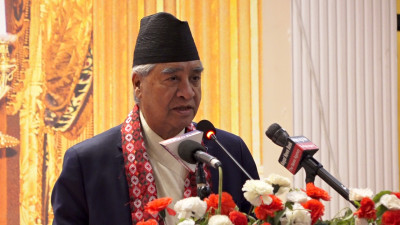
During the session, General Secretary Bishwa Prakash Sharma presented an organizational report. General Secretary Sharma commented that the change of government 30 times in the last 34 years is an indicator of political instability and leadership failure. He stated that while a change in government brings hope, long-term instability has pushed citizens toward despair.
The following are some points presented by General Secretary Sharma in the closed session:
- The economic growth rate we measure was already weak; one can imagine the condition of unemployed youth wandering in search of jobs in the face of market prices that a salary cannot sustain. Meanwhile, they kept hearing about corruption scandals.
- In the past 34 years, the government has changed 30 times in the country. This in itself is a record of our incompetence, extreme instability, and a shameful statistic. We thought each turn of government change would kindle hope, but long-term instability pushed the country towards despair rather than hope.
- We failed to create a situation where we could say that despite changes in government, there is policy stability and thus the journey of prosperity will not be affected. In a country where development priorities keep changing, plans are made or destroyed on a whim, or budgets are allocated from the perspective of political gain, it is natural that such a country cannot move forward at the expected pace of progress.
- However, despite the instability, much work was done in the fields of education, health, communication, and physical infrastructure over the past 30 years. The extensive expansion of the private sector was a byproduct of our policies. But due to the discussion of numerous corruption cases and a lack of good governance, the progress that was made became overshadowed.
- We moved to federalism, but by delaying the transfer of rights that should have been given to the provinces, we did not help provincial governments become strong and successful as expected. The Chief Ministers themselves were not happy or satisfied with Singha Durbar, yet we remained under the illusion that citizens in remote areas were happy with us.
- When farmers do not get fertilizer easily during the planting season, and sugarcane farmers have to travel to Kathmandu to demand payment, no farmer standing on the edge of their field will shout long live the government. How can any worker sing a song of joy when they have to repeatedly pressure the state just to receive the minimum wage? After experiencing hassles while standing in line at administrative offices, how can a service seeker praise the government and the party in power?
- The country has certainly not reached the economic capacity to provide education and health to citizens for free, but while the insurance program brought for citizen health was raising hope, it could not be made successful at the expected pace. People had to bear expensive treatment costs.
- Our ambassadors were our medium for establishing mature diplomatic and professional relations with the world for Nepal's prosperity, but despite having many qualified personalities in the diplomatic service, we resorted to power-sharing in ambassadorial appointments as well. Some selections were appropriate, but fundamentally, this kept raising questions about our methods and contributed to an increased negative image among the citizenry.
- Looking back, was there any sector left that was not plagued by politicization? Were the citizens not fed up with this? Why did we not want to understand the deep reality that every sector has its own dignity, its own separate identity, and its own distinct professional psychology? Why did we need "our people" everywhere? Not anticipating the ill effects this would cause was our serious mistake.
- The Education Bill reached Parliament after a long wait, but failing to bring it to a conclusion maintained dissatisfaction among teachers and school employees. It was sad in itself that teachers had to protest repeatedly to get an education bill passed that aligns with changing times.
Published Date:
2026-01-12 13:07:00
Comment Here
More
Political

Recent
Overnight Rescue Operations Underway at Chilime Tunnel
September 14, 2026
Nepal Esports League Added to Calendar
September 14, 2026
National Children's Rights Day Being Celebrated
September 14, 2026
Bhotekoshi Flood: 1,386 Bodies Recovered
September 13, 2026News
Overnight Rescue Operations Underway at Chilime Tunnel
September 14, 2026
National Children's Rights Day Being Celebrated
September 14, 2026
Bhotekoshi Flood: 1,386 Bodies Recovered
September 13, 2026