What is Nischal’s connection with ‘Lali Bazar’, praised by the Badi community?

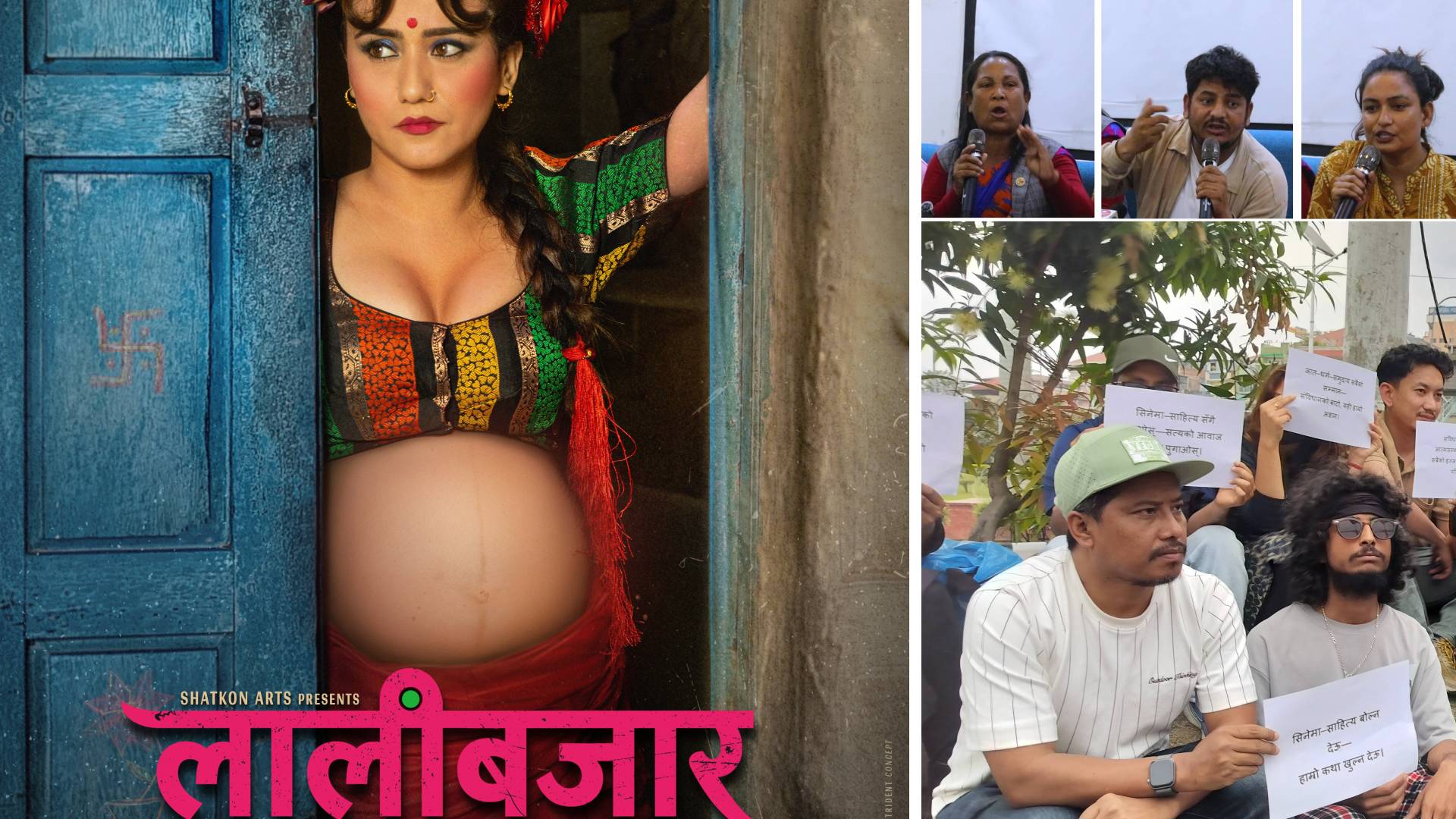
The Nepali film ‘Lali Bazar’ was scheduled for release on March 1. However, following a writ petition filed at the Patan High Court, the court issued a short-term interim order to halt the film's screening until May 5 and called both parties for discussion.
Film industry professionals have expressed dissatisfaction as the screening of ‘Lali Bazar’ was stopped at the last moment despite having its script passed by the Film Development Board and receiving a ‘Universal’ certificate from the Central Film Censor Board.
Related film organizations reacted by stating it is saddening to stop a film—which was already passed by government agencies—due to a single individual's petition claiming it hurts communal sentiments, especially without a discussion between both parties. They emphasized that there must be freedom of expression in art, film, and literature.
Stating that film stories are fictional and that stopping a release at the final hour based on depicted events is a wrong practice, organizations including the Nepal Film Producers Association, the Nepal Motion Picture Association (distributors and exhibitors), and the Nepal Film Directors Guild have made their positions public. Uday Kumar Ingnam, president of the Producers Association, stated that filmmakers would stand united to fight for artistic and expression freedom.
He said, “Film is not just a medium of entertainment but a powerful tool for thoughts and freedom of expression; hence, stopping its screening is saddening. It creates suspicion across the entire industry when obstacles are created based on a single person's accusation just as the film prepares for release. Halting the show when the state’s legitimate body, the ‘Central Film Censor Board,’ has already granted permission weakens the morale of independent investors and creators.”
He expressed full faith in the rule of law and the judiciary while demanding an end to the tendency of banning or obstructing creations. Similarly, Janakdeep Parajuli, president of the Directors Guild, said that stopping a film’s release narrows the creative scope.
“Film is a powerful art form that expresses various realities, thoughts, and sensibilities of society. In a democratic system, it is our clear belief that creators should be able to present their work freely within the scope of freedom of expression guaranteed by the constitution.
The making of a film is the result of long-term dedication and creative labor from directors, writers, actors, and hundreds of technicians. When a film is stopped at the last moment, it causes both artistic and financial loss; it is necessary for the state to think responsibly about this,” President Parajuli said.
Narendra Maharjan, president of the Film Association, an umbrella organization for distributors and exhibitors, stated that the halt causes losses to both the production side and the exhibitors (theater owners).
“When a film’s release is stopped, the production side suffers, but we exhibitors also face uncertainty about which film to screen at the last moment. This directly and indirectly affects many people; therefore, we demand that the respected court consult with film-related organizations or government bodies like the Film Development Board and the Central Film Censor Board before making such decisions,” Maharjan said.
He expressed disagreement with the decision to stop the release based on the fact that the story was prepared against the backdrop of a certain community. Previously, films like ‘Pandit Bajeko Lauri’ (due to the Badi community context), ‘Actor’ (due to the name), and ‘Laj Sharanam’ (due to a resemblance to Nepali Congress leader Aftab Alam) were also stopped at the last hour, though they were later screened freely. To protect creative freedom, quality, and professional rights in the Nepali film sector, filmmakers have emphasized artistic freedom of expression.
‘Lali Bazar’ Dispute: The Writ, Legal Process, and Previous Precedents
A previous Supreme Court decision regarding a similar case involving ‘Lali Bazar’ can be viewed as a reference. Regarding a writ filed on 2075 Ashoj 4, against the film ‘Pandit Bajeko Lauri’ and the novels ‘Nathiya’ and ‘Ailani’—which were based on stories of the Badi community—the Supreme Court ruled on 2075 Falgun 15, that there was no need to issue a mandamus to stop the publication or screening.
In the full text of the verdict (2076 Baishak), the court stated the works were not against the law and decided not to issue a mandamus. However, the court issued a directive order to the Film Development Board and the Central Film Censor Board to control the screening of materials that could harm the dignity, honor, and self-respect of any community.
Following that directive, preliminary studies of stories and materials are conducted during film production, and necessary testing and classification are done by the Censor Board before release. ‘Lali Bazar’ has already received a ‘Universal’ certificate from the Censor Board, indicating it has met the specified standards.
The board had set conditions to remove or mute some dialogues, which the production team has already fulfilled. It is also reported that the film includes a disclaimer at the beginning stating, “The characters and events shown are fictional.”
Arguments have been presented that, based on previous precedents, it can be assumed the film does not hurt any community's feelings since regulatory bodies have fulfilled their roles. However, out of respect for the judicial process, ‘Lali Bazar’ has been forced to stop its screening until May 5.
What Badi Community Activists Say
The Badi community has praised the film ‘Lali Bazar,’ produced by Shatkon Arts, saying it shows their story. Activists from the Badi community who have seen the film stated that since the main story focuses on a mother and daughter, there is no subject or context in the film that insults or hurts the sentiments of the Badi community.
Activist Debisara Badi said the film presented her mother’s story and that it brought tears to her eyes. She said, “We have already seen the film. We had objections to a few words, which the production side removed, and we are grateful. This story or the film ‘Lali Bazar’ has done nothing to hurt our community's feelings. On the contrary, it shows our story of struggle and rebellion. It has encouraged us even more to fight for our rights.”
She stated that once ‘Lali Bazar’ is released publicly, she will show it to the women of her community through her organization. Similarly, Hikmat Badi, known as a Badi community activist, clarified after watching the film that there is no intention in ‘Lali Bazar’ to hurt the community's sentiments.
“This is a story of a mother from the Terai. After removing the words we objected to, there is no reason to object to or stop the film. The time has come to raise our voices against the exploitation we faced; we are already raising it on the streets. In the film, too, our voice of protest is being heard through art, and I don’t think there is anything bad in that.”
He said the mother’s struggle to save her daughter from rulers and exploiters would give Badi women and women from other communities the strength to fight against injustice. Rama Badi mentioned that a doctor cannot treat a hidden wound until it is seen.
“We didn’t come with the intention of watching a film; we reached Singha Durbar to ask why the agreement made with our government was not implemented. There, we found out a film had been made about our community's story, and we watched it. We have already given our opinion. This film is basically a story of a mother and daughter. The struggle a mother fights for her daughter against exploitation by the ruler is an inspiration for all of us. This is our mother's story, who fought for us,” she said.
Additionally, Padam Rana Badi, Ramesh Gandharba Badi, and others said they had watched the film and found no scenes or dialogues objectionable to the community.
What is Nischal Basnet’s connection with ‘Lali Bazar’?
The film ‘Lali Bazar,’ produced by Shatkon Arts, has Max Dipesh Khatri as the producer and Pradip Bhattarai as the executive producer. After the respected court issued a temporary halt on the screening until May 5, film-related organizations held a joint protest program at Maitighar Mandala.
Actor Khagendra Lamichhane, directors Manoj Pandit, Ganeshlal Pandey, Suyog Gurung, Raunak Bikram Kandel, Michael Chand, and director Nischal Basnet were present at the protest organized by the Nepal Film Producers Association, Nepal Motion Picture Association, and the Nepal Film Directors Guild. Nischal, who often raises his voice against injustice, expressed his disagreement this time as well, stating that stopping a film at the last moment of its release is wrong.
He stated that there is no creative freedom if a film, which has been granted a permit for screening by a government body, is stopped based on an accusation by a single individual at the final hour.
He is not associated with the film as a producer, director, or actor. Nor did he raise his voice solely for ‘Lali Bazar.’ He expressed his views as part of his responsibility as a member of the film industry.

-1781596008.jpeg)
-1781503778.jpeg)
Bhote Koshi Flood Update: 1,409 Bodies Recovered
September 17, 2026
Four Bodies Found Inside Chilime Hydropower Project Powerhouse
September 16, 2026
Bhote Koshi Flood Update: 1,409 Bodies Recovered
September 17, 2026
Four Bodies Found Inside Chilime Hydropower Project Powerhouse
September 16, 2026