Election Commission Approves New Procedures for Election Campaign Bank Accounts

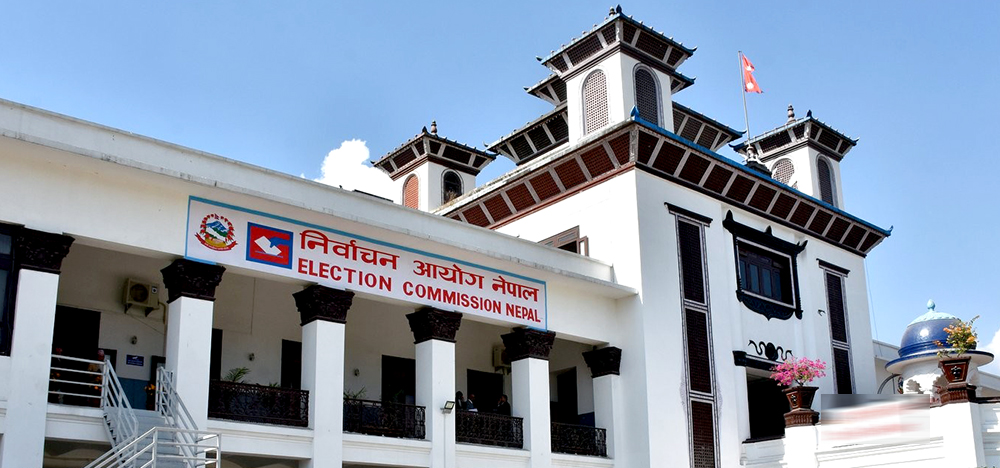
KATHMANDU - The Election Commission has approved the 'House of Representatives Member Election Campaign Bank Account (Operation and Management) Procedures, 2082' to make election expenditures transparent and economical.
The Commission stated that these procedures, approved this past Tuesday, are intended to control, monitor, and discipline the campaign expenses incurred by political parties and candidates during the House of Representatives elections.
According to the procedures, political parties and candidates must now mandatorily open a separate bank account for election campaigning. For this, political parties must submit an application in the prescribed format to the Commission's Secretariat, and candidates must apply to the respective election office.
Along with the application, an official letter from the party, the candidate's candidacy certificate or identity card, a signature specimen card from the relevant bank, and the citizenship certificate of the account operator must be submitted.
Banks and financial institutions will open the account only after the Commission or the election office verifies the documents and provides a recommendation. Information regarding the opening of the account must be compulsorily provided to the Commission, the election office, and the Treasury and Accounts Controller Office.
As per the procedures, in the case of political parties, the account can only be operated through the joint signatures of a maximum of two officials designated by the party. In the case of candidates, the account can be operated by the candidate themselves or by a person authorized by them, through a single signature or the joint signatures of a maximum of two people. Additionally, the procedures specify that all income and expenses related to election campaigning must be conducted in Nepalese currency.
Voluntary financial assistance, expenses incurred during campaigning, and payments made via checks, drafts, TT, or electronic means must all be processed through the bank account.
Political parties and candidates are not allowed to accept assistance exceeding Rs 25,000 in cash. Such amounts must be deposited directly into the bank account. For amounts less than Rs 25,000, the provision allows for collecting the cash by issuing a receipt or voucher and subsequently depositing it into the account.
The procedures strictly prohibit taking financial assistance from entities and individuals restricted under the Political Parties Act, 2073. It is completely forbidden to accept assistance from the Government of Nepal, provincial or local level bodies, government-owned or controlled institutions, public limited companies with public shares, government or community educational institutions, national and international non-governmental organizations, foreign governments or individuals, anonymous individuals or organizations, and other institutions specified by the Commission.
The procedures mandate that when receiving assistance exceeding Rs 100,000, the name, address, profession, Permanent Account Number (PAN), source of funds, and tax-related details of the assisting individual or organization must be disclosed.
Funds existing in election expense-related bank accounts opened before the implementation of these procedures must be transferred to the new accounts opened under the new procedures. "Political parties or candidates must transfer the funds received by opening bank accounts for election campaign purposes prior to the implementation of these procedures into the bank accounts opened according to these procedures," the document states.
After the completion of the election, parties and candidates must make the details of their election campaign expenses public and submit them to the respective election office.
The bank account will be ordered to be closed within 35 days of the preparation of the report on those details, but the account records must be kept secure for six years. The Commission can order the closure of the account at any time if a party is dissolved or a candidacy is canceled.
The procedures have assigned the responsibility of monitoring the expenses incurred by political parties and candidates in the election to the head of the Treasury and Accounts Controller Office (DTCO). The head of the DTCO will carry out such surveillance as the Election Code of Conduct Monitoring Officer.
The monitoring will collect detailed information on whether government employees or public property have been misused, whether assistance was taken from prohibited entities, whether spending limits were exceeded, and whether expenses were incurred for prohibited activities.
Provisions have been made to treat documents and details related to the bank account as confidential and inviolable under prevailing laws. However, there is a clear provision that the Election Commission or an official authorized by the Commission can conduct an audit or examination of the account if deemed necessary.
In previous elections, serious questions have been raised regarding the source, volume, and use of campaign expenses. Practices such as opaque transactions in the name of voluntary assistance, cash expenditures, receiving aid from prohibited entities, and the tendency to exceed spending limits have added challenges to the fairness and good governance of elections.
In this context, the Commission stated it has implemented these procedures to effectively execute Section 16 of the Election Code of Conduct, 2082, and to make the elections organized and dignified.



Overnight Rescue Operations Underway at Chilime Tunnel
September 14, 2026
Nepal Esports League Added to Calendar
September 14, 2026
National Children's Rights Day Being Celebrated
September 14, 2026
Bhotekoshi Flood: 1,386 Bodies Recovered
September 13, 2026
Overnight Rescue Operations Underway at Chilime Tunnel
September 14, 2026
National Children's Rights Day Being Celebrated
September 14, 2026
Bhotekoshi Flood: 1,386 Bodies Recovered
September 13, 2026