Rabi-Balen Alliance: A Shock to Deuba, Oli, and Dahal

KATHMANDU. Significant upheaval has been observed in the Nepali political sphere recently. Following the Gen-Z movement on September 8th and 9th (Bhadra 23 and 24), Nepali politics has taken an unexpected turn.
The government formed by the Congress-UML coalition collapsed shortly, leading to the formation of a Gen-Z government under the leadership of Sushila Karki.
Despite the formation of the government, political instability persists. Meanwhile, new equations are emerging between new and old parties. New parties seem oriented toward mutual cooperation, while old parties are also attempting to reunite.
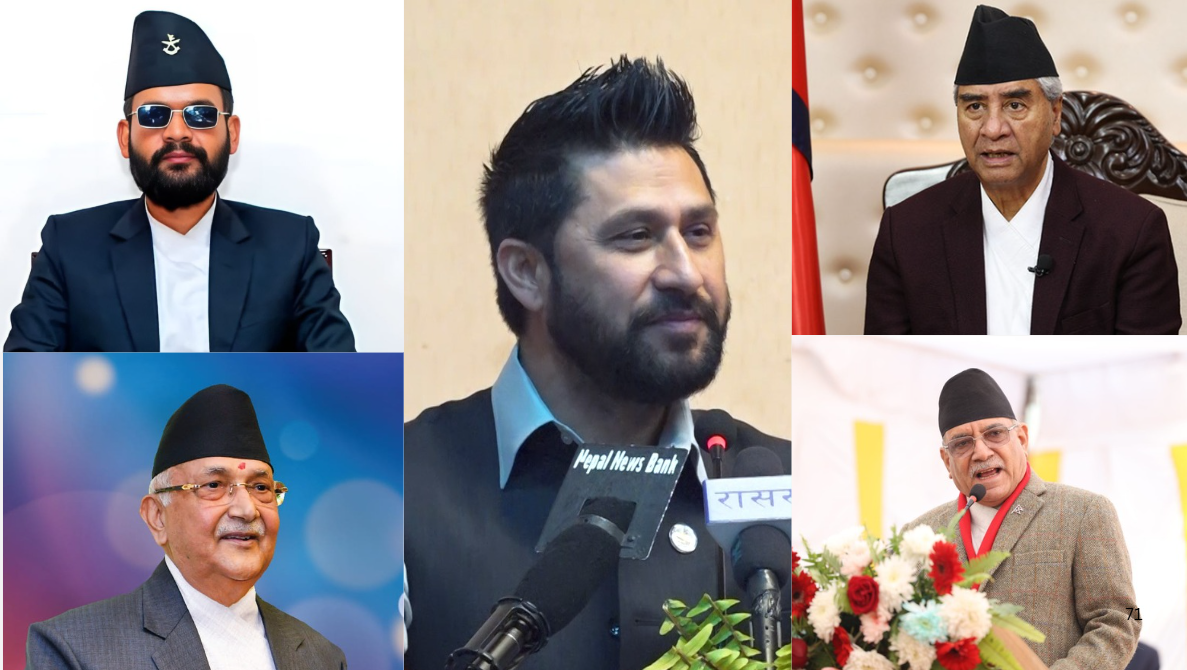
In this context, rumors have surfaced that Rastriya Swatantra Party (RSP) Chairman Rabi Lamichhane and Kathmandu Metropolitan City Mayor Balen Shah are set to stand on the same political front.
According to the agreement, Rabi Lamichhane will lead the party, and Balen Shah will be projected as the prime ministerial candidate. However, one significant name is missing from this story of union: Kulman Ghising.
For RSP, which was the fourth-largest party in the dissolved parliament, relinquishing both the party chair and the prime ministerial post for the sake of consensus is not considered a politically easy decision.
Lamichhane’s popularity has already been proven through two elections. The party possesses its own voter base, organization, and the participation of experts from various fields. In such a situation, being ready to give up the Prime Minister's post based on "borrowed popularity" is viewed as an unusual decision.
If Balen Shah becomes the Prime Minister, questions regarding Kulman Ghising's potential role are natural. On the other hand, Balen is no less popular than Rabi. He is a primary choice, especially among the Gen-Z generation.
Balen is regarded as a leader who has successfully put alternative politics into practice. He has established the belief that independent candidates can also win elections.
The future political direction appears to depend on the democratic process. If an agreement is reached, they may compete in the elections jointly; otherwise, there remains the possibility of contesting separately in a cordial manner.
However, this has also given rise to many doubts. Some fear that impunity might increase and foreign intervention could rise, questioning national sovereignty.
Nevertheless, the potential collaboration between Balen and Rabi has led to predictions that the decades-long political dominance of traditional leaders—Nepali Congress President Sher Bahadur Deuba, UML Chairman KP Sharma Oli, and Nepal Communist Party Coordinator Pushpa Kamal Dahal (Prachanda)—will directly decline.
Serious questions arise regarding the kind of political shock Deuba, Oli, and Dahal might face.
Questioning the Legitimacy of Leadership
Although Deuba, Oli, and Dahal have been at the center of power for decades, they face allegations of failing to deliver expected results in good governance, employment, and development. The Rabi-Balen collaboration will draw a clear line of "Old Faces vs. New Alternatives," which could further question the moral and political legitimacy of these leaders.
Pressure on Coalition Politics
If the Rabi-Balen front becomes strong, old parties may be forced to form interdependent coalitions again. This will weaken their self-reliant political status and make the bargaining for government formation even more complex.
If the old parties move forward with electoral unity, it will certainly become a noose for the so-called alternative and new parties. This is because the old parties have roots reaching down to every village, and the psychology of rural voters has not yet changed. Reliable trust in the "new" has not yet been fully established.
Risk of Losing Control Over Urban and Youth Politics
With Balen and Rabi’s influence in urban areas gaining national-level reach, the sphere of influence for old leaders could become limited. This shock is likely to be long-term.
However, other analysts believe that the old parties will not let their established dominance slip away so easily, as the prestige, personality, and social image of the "new" leaders do not appear entirely untainted.
Rising Internal Dissatisfaction and Succession Issues
The rise of a new generation will intensify the pressure for leadership change within the Congress, UML, and the Nepal Communist Party. Dissatisfied second-generation leaders may begin to question their own leadership.
The collaboration between Rabi and Balen is not just a new alliance; it could be a signal of the biggest electoral challenge to the long-standing political monopoly of Deuba, Oli, and Dahal.
If this collaboration enters the electoral battlefield, there is a high probability that the old leaders will face a structural, rather than temporary, shock.

Overnight Rescue Operations Underway at Chilime Tunnel
September 14, 2026
Nepal Esports League Added to Calendar
September 14, 2026
National Children's Rights Day Being Celebrated
September 14, 2026
Bhotekoshi Flood: 1,386 Bodies Recovered
September 13, 2026
Overnight Rescue Operations Underway at Chilime Tunnel
September 14, 2026
National Children's Rights Day Being Celebrated
September 14, 2026
Bhotekoshi Flood: 1,386 Bodies Recovered
September 13, 2026