Clearing Up Misconceptions Grounding Alone Won’t Prevent Electrocution

-1762666201.jpeg)
By Saroj Joshi, PE, Ph.D.
Electrical grounding is a fundamental aspect of safe electrical system design, yet misconceptions persist — even among professionals, professors, engineers, and technicians — regarding the relative “safety” of copper wire versus flat braid or metal strap grounding.
Misconception: “Copper wire is inherently safer than flat braid or metal strap”
This is incorrect.
If the cross-sectional conductive area is the same, copper wire and flat braid/metal strap provide the same low-impedance path for fault current at standard 60 Hz power. The physical shape only affects performance under high-frequency or transient conditions, such as lightning, EMI, or sensitive electronics applications:
- Flat braid/strap: lower impedance for high-frequency currents; better for lightning and surge applications.
- Round copper wire: slightly higher impedance at high frequencies, but electrically equivalent for normal 60 Hz power faults.
For routine grounding in branch circuits, service equipment, or standard installations, either type works effectively if properly sized and installed according to NEC ( National Electrical Code- USA)
requirements.
Grounding Does Not Protect Life Directly
A grounded conductor does not inherently prevent electrocution.
- During a fault, if someone touches grounded equipment or a ground wire, current can still flow through the body.
- Grounding provides a low-impedance path for fault current, which allows protective devices to operate.
- Even if 99% of the fault current flows through the conductor, the remaining 1% through a human body can be lethal.
Example:
- Fault current = 10 A
- 1% through the body = 0.1 A (100 mA) → sufficient to stop the heart
Thus, contact with energized grounded equipment is still dangerous, even with a properly installed ground.
Protection of Human Life Comes From Devices
The real protection for human life comes from properly functioning protective devices:
- Circuit breakers and fuses – rapidly interrupt fault current
- GFCI/AFCI devices – trip in milliseconds when leakage occurs
- Correct bonding – ensures all exposed metal is at the same potential
Grounding conductors enable these devices to function effectively, but they do not prevent electrocution on their own.
Key takeaway:
Protection of human life is achieved only through protective devices. Grounding conductors, whether wire or flat strap, are critical for system safety and rapid fault clearing, but do not provide life protection by themselves.
Practical Guidance
- Size grounding conductors per NEC tables.
- Ensure solid, low-impedance connections.
- Select and maintain appropriate protective devices.
- Use flat straps where high-frequency, surge, or lightning performance is needed; wire is sufficient for normal power faults.
Grounding ensures system protection; protective devices save lives.
Routine checks at local, county, and state levels are essential to ensure electrical systems comply with life safety standards. Reliable statistics are lacking worldwide—while the USA sees ~1,000 electrocution deaths per year and India ~11,000, most countries have no accurate data. ILO and WHO should maintain global records to enforce mandatory safety measures effectively.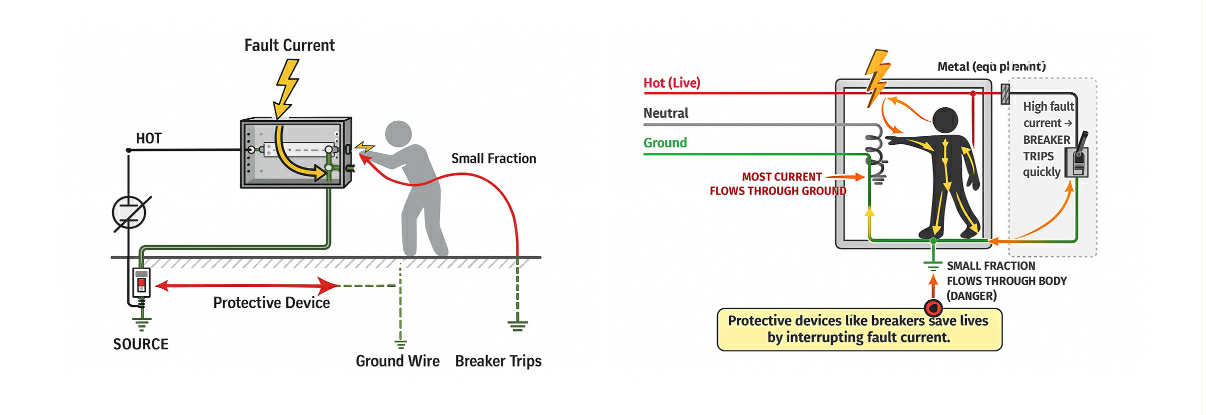

-1762666201.jpeg)


6 Members Appointed to B.P. Koirala Memorial Cancer Hospital
September 22, 2026
Breaking Tradition, Prime Minister Shah Skips Ceremonial Farewells
September 22, 2026
Nepal and Bhutan Must Strengthen Cooperation on Climate Change
September 22, 2026
Breaking Tradition, Prime Minister Shah Skips Ceremonial Farewells
September 22, 2026
Nepal and Bhutan Must Strengthen Cooperation on Climate Change
September 22, 2026

Bhotekoshi Flood Update: 1,451 Bodies Recovered
September 22, 2026