Can Dogs Also Recognize Spoken Words from Humans?

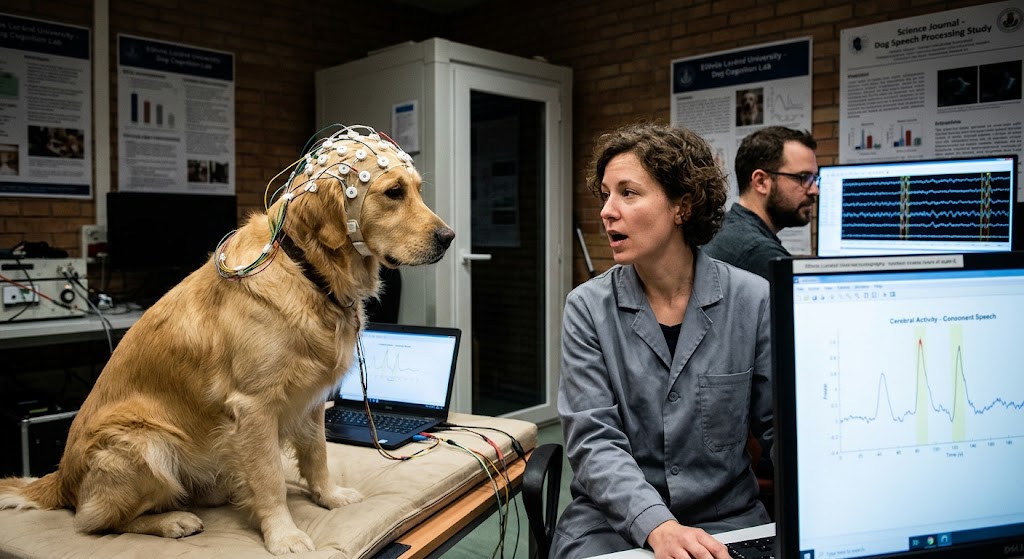
Kathmandu. A new scientific study shows that dogs can process continuous human speech based on rhythm and show a specific neural response toward word structures anchored in consonant sounds.
According to researchers, this kind of "consonant bias" has been confirmed in a non-human brain for the first time. The study, conducted by researchers at Eötvös Loránd University in Budapest, Hungary, was published in the prestigious journal Science.
In the experiment, brain activities of 20 humans and 20 pet dogs were compared while listening to continuous speech without distinct individual words. Scientists used non-invasive EEG technology to observe how the brain synchronizes with speech rhythm. According to the lead researcher and cognitive neuroscientist Attila Andics, because consonants form the core structural framework of words rather than vowels, canine brains reacted more strongly to those structural patterns.
The test utilized speech with repeating three-letter patterns based on either consonant or vowel sounds, alongside a control sound group without regular patterns. The findings revealed that when hearing speech structured around consonants, dogs' brains exhibited strong neural alignment with speech rhythm, similar to humans. According to psychologist and co-lead author Kinga G. Tóth, brain activity changes recorded approximately 400 milliseconds after a word began signaled the neural process involved in segmenting distinct words out of continuous speech.
Another intriguing finding of the study is that dogs spending the first three months of their lives on the street or in shelters also demonstrated this consonant bias. Researchers note that this suggests such a capacity is not solely reliant on innate language machinery, but can also develop through regular exposure to human speech.
However, certain key differences between humans and dogs were noted. Humans could distinguish word boundaries based on vowel sounds to a degree, whereas dogs could not. Furthermore, while the human brain demonstrated fine-grained processing down to individual phonetic units, dogs used the syllable as their smallest processing unit.
Researchers conclude these findings show that despite lacking full human-like language faculties, a dog's brain can learn fundamental patterns of language structure through regular immersion in human speech. — ANI






Water Flow to Remain Normal in Most Rivers Across Nepal for Next Three Days
September 28, 2026
Can Dogs Also Recognize Spoken Words from Humans?
September 28, 2026
6 Dead, 3 Missing in Myagdi Landslides
September 28, 2026
Floods in Saptari: 500 Houses Submerged, Over 2,000 People Affected
September 27, 2026
Water Flow to Remain Normal in Most Rivers Across Nepal for Next Three Days
September 28, 2026
6 Dead, 3 Missing in Myagdi Landslides
September 28, 2026
Floods in Saptari: 500 Houses Submerged, Over 2,000 People Affected
September 27, 2026
Landslide interrupts 33 kV power line in Manang
September 27, 2026