
NRNA Needs to Transform into a 'Work-Oriented' Structure, Not 'Election-Oriented': President Shrestha

London – Mahesh Kumar Shrestha, President of the Non-Resident Nepali Association (NRNA), has stated that the NRNA needs to be transformed into a 'work-oriented' structure, rather than an 'election-oriented' one.
Speaking at an interaction program organized by Nepal Britain Dotcom on Friday, President Shrestha emphasized the need for fundamental changes in the NRNA's statute and structure, urging an examination of the organizational frameworks of international bodies like the United Nations, Lions Club, and Rotary Club.
He described the recent unity within the organization not merely as a technical agreement but as the organization's rebirth. He stated that the past four years of uncertainty, conflict, and division had weakened the trust of Nepalis worldwide, the Government of Nepal, and civil society in the NRNA, and clarified that the current unity has restored that lost faith.
President Shrestha indicated that the unity was compelled by certain circumstances. He mentioned that after a long wait for the Supreme Court's verdict was thwarted—when judicial files were destroyed following the protests of (Bhadra 23-24)and the Ministry of Foreign Affairs (MoFA) issued a stern warning, even threatening to 'dissolve the NRNA itself,' the pressure for unity was created.
He also stressed the need to select a new leadership based on consensus in the upcoming general convention.
He stated that this unity was not a victory for any single side, but that the main catalyst was the shared understanding that both sides must 'give up something' to save the organization.
He added that the 10-point agreement reached on Mangsir 14, which accepted the existence of both groups and set a target to hold new elections within six months, has laid the foundation for making this unity sustainable.
'Although the goal is to hold the general convention within the next six months (preferably before the House of Representatives elections), the confusion over the election system remains the main challenge.
We will coordinate with the Ministries of Foreign Affairs and Law to resolve the dispute—whether voting will be done by coming to Nepal or through online voting from abroad—to ensure the question of legitimacy does not arise,' he said.
Regarding investment in Nepal, he stated that with the low possibility of Foreign Direct Investment (FDI) coming in due to the instability following the Gen Z movement, this is the right time for Non-Resident Nepalis to invest.
He emphasized that Nepalis, who collectively possess assets many times greater than Nepal's GDP, must bring not only investment but also a culture of work, knowledge, and technology to Nepal.
He also informed that the government is very positive regarding the issues raised by Non-Resident Nepalis concerning citizenship, voting rights, and the People of Nepali Origin (PNO) identity.
He expressed confidence that rights over matters such as land, bank accounts, and immigration, excluding political rights, can be obtained through a decision or circular from the Council of Ministers itself.
He stressed the necessity of a policy that stops sending workers to countries without labor agreements and seeks a guarantee of social security, to prevent human trafficking occurring under the guise of foreign employment.
President Shrestha also announced that the NRNA will move forward with an ambitious plan for the eradication of poverty and unemployment. 'We have planned to collaborate with all three levels of government in Nepal on this major campaign, which aims to lift 1.5 million poor families above the poverty line within 15 years,' he said.
President Paudel Performs Puja and Worships Nava Durga Bhawani
October 25, 2026
Kojagrat Purnima is being celebrated nationwide today
October 25, 2026
Traffic Police Penalize 336 Drivers in 24 Hours
October 24, 2026
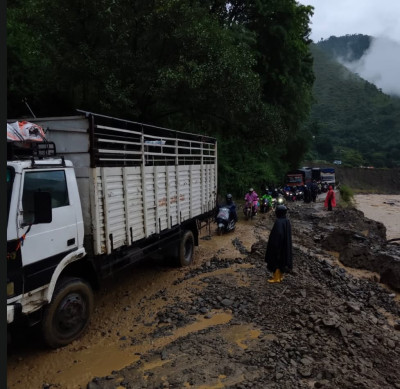
BP Highway Reopens After Debris Cleared
October 10, 2026