Mecca Pact: What Does a New Middle Eastern Security Order Mean for Nepal?

-Om Charan Amatya
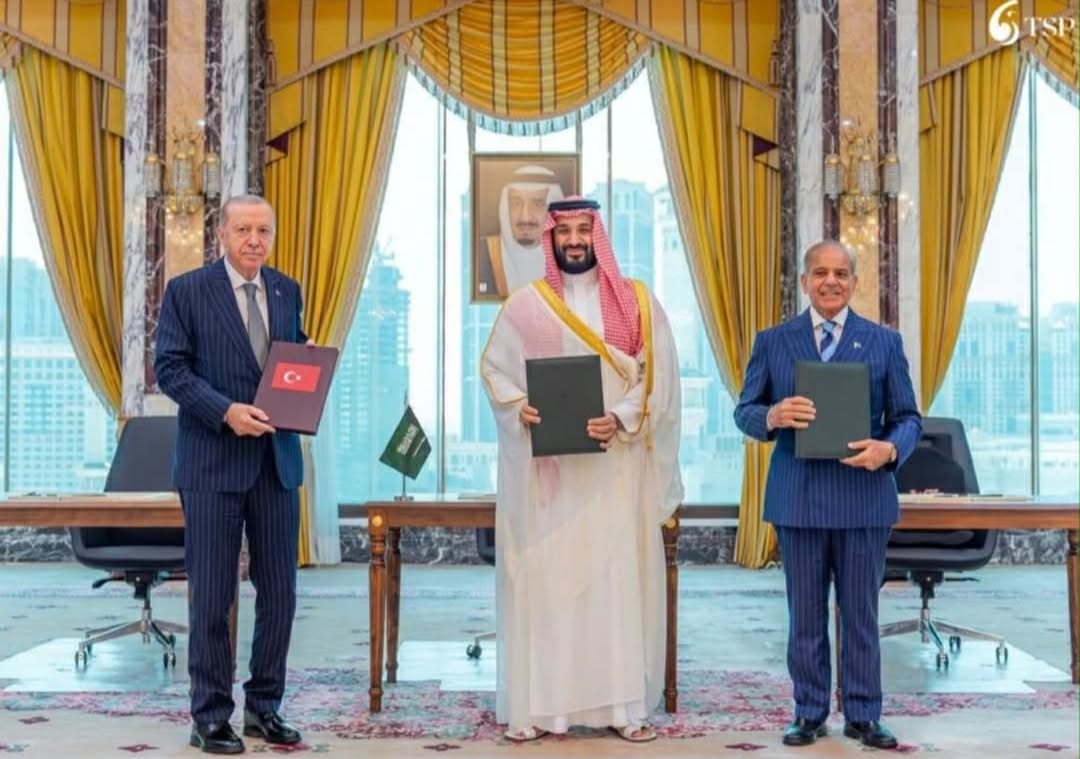
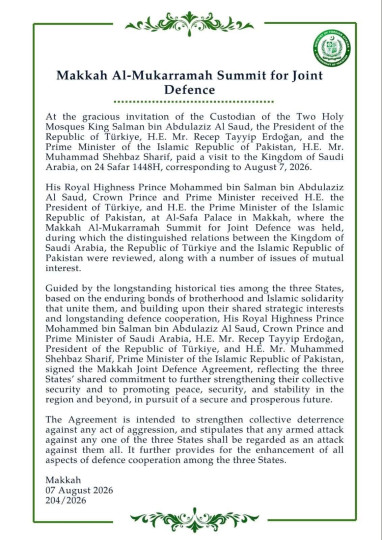
The signing of the Mecca Joint Defence Agreement by Saudi Arabia, Türkiye and Pakistan on August 7 has opened a potentially significant new chapter in the changing geopolitical landscape of the Middle East.
The agreement stipulates that an armed attack against any one of the three countries will be regarded as an attack against all three, while also providing for enhanced defence cooperation. Turkish Foreign Minister Hakan Fidan has described it as technically comparable to NATO’s Article 5, although the nature and extent of assistance would depend on circumstances.
The choice of Mecca as the venue for signing the agreement is itself symbolically significant. Mecca is Islam’s holiest city and the home of the Kaaba, revered by Muslims across the Sunni and Shia traditions.
By giving the agreement the name of Mecca and signing it in Islam’s most sacred city, the three countries may also be signalling a broader political message: that their security cooperation is being presented not merely as a conventional military arrangement among three states, but as a partnership carrying a wider Islamic and regional identity.
Whether that symbolism can translate into broader cooperation among Muslim-majority countries remains uncertain. Nevertheless, it could give the pact an additional political resonance that a conventional defence agreement signed elsewhere might not possess. At first sight, the agreement may appear to have little to do with Nepal. Yet international politics rarely remains confined to geography. A change in the strategic balance of one region can have consequences far beyond its immediate neighbourhood. For Nepal, therefore, the significance of the Mecca Pact lies less in its immediate military provisions than in what it reveals about a changing international security environment in which countries increasingly seek diversified strategic partnerships and greater strategic autonomy.
A Changing Middle East
The pact has emerged at an exceptionally turbulent moment. The continuing regional conflict involving the United States, Israel and Iran has exposed vulnerabilities in the traditional US-led security architecture in the Middle East. Missile and drone attacks, tensions around the Strait of Hormuz and threats to regional infrastructure have demonstrated how quickly a Middle Eastern conflict can affect energy markets and the global economy. For decades, Saudi Arabia and other Gulf states have depended heavily on the United States for security.
The current crisis appears to have strengthened the argument for diversifying security partnerships. This does not mean that Saudi Arabia, Türkiye or Pakistan are abandoning Washington, nor does the pact necessarily constitute a Middle Eastern equivalent of NATO. Rather, it appears to be an effort by regional powers to create additional strategic options and collective deterrence. Is Iran the Real Target? The agreement does not explicitly identify Iran as an adversary. Nevertheless, Iran’s regional role cannot be ignored. Saudi Arabia has obvious security concerns, while Pakistan shares a border with Iran and has historically maintained relations with both Tehran and Riyadh.
Türkiye, meanwhile, occupies a strategically important position between Europe, Asia and the Middle East. The pact should therefore not automatically be interpreted as an anti-Iranian alliance. Its larger significance may be the attempt by regional powers to strengthen their security without entirely abandoning existing relationships with Washington or diplomacy with Tehran.
The Houthi Test The most immediate test of the pact could come from Yemen. If Houthi attacks against Saudi Arabia continue or intensify, an important question will arise: would such attacks trigger the collective-defence commitment of the Mecca Pact?
The answer is not necessarily that Pakistan and Türkiye would immediately enter the conflict militarily. The agreement creates a security commitment, but the form and extent of assistance would depend on how its members interpret the circumstances. For Pakistan, the issue is particularly sensitive because it shares a border with Iran and has traditionally sought a balance between Tehran and Riyadh.
Türkiye would likewise have to weigh its regional ambitions against the danger of becoming involved in another conflict. The Houthi challenge could therefore provide the pact’s first real-world test—revealing whether it is primarily a political deterrent or an operational collective-security mechanism. The consequences could extend beyond Saudi Arabia and Yemen. Continued Houthi attacks or threats to shipping in the Red Sea could affect freedom of navigation, trade and energy markets. For Nepal, such instability could ultimately mean higher fuel prices, disrupted air routes and greater risks for Nepali workers in the Gulf.
Could the Pact Expand?
An even more consequential question is whether the Mecca Pact could expand beyond its three founding members. Türkiye has indicated that the agreement is open to additional members, with Egypt emerging as a particularly important prospective participant. If other Muslim-majority countries eventually join, the pact could acquire considerably greater political, economic and military weight.
A broader grouping could create another important centre of influence in the Middle East and strengthen the collective bargaining power of its members in relation to the United States, China, Russia and European powers.
It could also influence the strategic calculations of Iran, Israel and India. However, expansion would not be without complications. Potential members have different relationships with Iran, Israel, the United States and China, as well as different national security priorities. A larger organisation could therefore increase collective strength while making consensus more difficult.
So, the crucial question would be whether the pact could evolve into a broader security framework without becoming an instrument of confrontation against any particular country.
A Possible Shift in the Global Strategic Balance If the Mecca Pact remains trilateral, its impact may be significant but limited. If it develops into a wider regional security network, however, its implications could extend beyond the Middle East. Such a development would not necessarily mean the creation of an anti-Western or anti-Iranian bloc.
Rather, it could represent another stage in the emergence of a more multipolar international system, in which regional powers increasingly seek greater strategic agency instead of depending exclusively on external security guarantors. Overall, the result could be a world of overlapping partnerships rather than rigid alliances. This could strengthen regional deterrence, but it could also create new rivalries if competing security networks become antagonistic.
Why Should Nepal Care?
Nepal sits between China and India, two major Asian powers. Its traditional foreign-policy strength has been the ability to maintain relations with countries possessing competing interests without becoming militarily aligned with any one of them. This is why the Mecca Pact offers Nepal an important lesson: strategic autonomy and diversified international relationships may become increasingly important for smaller states.
Pakistan’s participation also gives the pact an indirect connection to China’s strategic environment. Saudi Arabia’s growing relations with China and Türkiye’s geographical position between Europe and Asia further connect the development to a wider network stretching across South Asia, Central Asia, the Middle East and China. India, meanwhile, will naturally watch the pact closely because of Pakistan’s participation, but its substantial economic and energy interests in the Gulf mean that it cannot view the agreement solely through the India-Pakistan prism.
For Nepal, the objective should not be artificial equidistance between India and China. It should be strategic autonomy grounded in national interest—maintaining constructive relations with India and China while also expanding ties with the United States, Russia, Europe, Japan, the Gulf and other key partners, including Pakistan and Bangladesh. Asia further connect the development to a wider network stretching across South Asia, Central Asia, the Middle East and China. India, meanwhile, will naturally watch the pact closely because of Pakistan’s participation, but its substantial economic and energy interests in the Gulf mean that it cannot view the agreement solely through the India-Pakistan prism.
For Nepal, the objective should not be artificial equidistance between India and China. It should be strategic autonomy grounded in national interest—maintaining constructive relations with India and China while also expanding ties with the United States, Russia, Europe, Japan, the Gulf and other key partners, including Pakistan and Bangladesh.
Given the fast-changing geopolitical environment around us, particularly the emergence of a multipolar world, it is high time for Nepal—an “India-locked” rather than “land-locked” nation—to restore the long-lost balance by reaching out to as many countries as possible, with trade on one hand and Panchasheel, the five principles of peaceful coexistence, on the other.
The Gulf and Nepal’s Economic Security There is an even more immediate reason for Nepal to watch developments in the Middle East: its migrant workers and remittance economy. According to the World Bank’s April 2026 Nepal Development Update, 77.3 percent of Nepali migrant workers are based in the Middle East, while Saudi Arabia, Qatar and the United Arab Emirates together account for approximately 37 percent of Nepal’s total remittance inflows. Remittances amounted to 16.6 percent of GDP in the first half of fiscal year 2025/26. Prolonged instability could therefore affect Nepal through employment, migration, remittances, aviation, tourism and household incomes.
The World Bank has already identified Middle Eastern instability as a risk to Nepal’s economic outlook. Energy is another vulnerability. Nepal depends heavily on imported petroleum products, and disruption in the Middle East—particularly around the Strait of Hormuz—could push up global oil prices and increase transportation, food and production costs. Middle Eastern security is therefore also an issue of Nepal’s economic security. Middle East, while Saudi Arabia, Qatar and the United Arab Emirates together account for approximately 37 percent of Nepal’s total remittance inflows. Remittances amounted to 16.6 percent of GDP in the first half of fiscal year 2025/26. Prolonged instability could therefore affect Nepal through employment, migration, remittances, aviation, tourism and household incomes. The World Bank has already identified Middle Eastern instability as a risk to Nepal’s economic outlook.
Energy is another vulnerability.
Nepal depends heavily on imported petroleum products, and disruption in the Middle East—particularly around the Strait of Hormuz—could push up global oil prices and increase transportation, food and production costs. Middle Eastern security is therefore also an issue of Nepal’s economic security.
Strategic Flexibility for Nepal Perhaps the most important lesson from the Mecca Pact is the growing importance of strategic flexibility. Nepal cannot become a major military power, nor should it seek to join competing security blocs. Its strength lies in diplomacy.
Strategic flexibility means maintaining constructive relations with India, China, the United States, Europe, Japan, the Gulf countries and other international partners, while ensuring that no single relationship compromises Nepal’s independent foreign-policy choices. The objective should be simple: expand Nepal’s choices—not create new dependencies.
What Happens Next?
The long-term significance of the Mecca Pact remains uncertain. Will it remain a trilateral defence arrangement or expand to include Egypt and other Muslim-majority countries? How will its members respond if Houthi attacks against Saudi Arabia continue? Will the United States adjust its regional security strategy? How will Iran, China and India respond to an evolving regional security network?
And, most importantly for Nepal: Will the emergence of new geopolitical networks make it more difficult—or more important—for Kathmandu to maintain its strategic autonomy between India and China? Nepal has no reason to take sides in Middle Eastern conflicts. But it cannot ignore their consequences.
The Mecca Pact was signed in Mecca, but its significance could extend far beyond the Middle East. For Nepal, the prudent response is neither alarm nor alignment. It is awareness, preparedness, strategic flexibility and diplomacy guided firmly by national interest. Nepal cannot choose its geography. It cannot change the size or power of its two giant neighbours. But it can choose the quality of its diplomacy. And in an increasingly uncertain and multipolar world, strategic autonomy may be Nepal’s most valuable strategic assets.
*Om Charan Amatya is the Chairperson of Center for Asian Studies (CAS)-Bhaktapur, Creative Head of Nepal Public Media Network (NPMN), Executive Director of Heritage Movies-Nepal, and Founder Chairperson of Organ Donors’ Association-Nepal (ODA-N).




Young Cricketer Upendra Rai from Saptari Passes Away
August 11, 2026
Gold Price Rises by NRs 6,400
August 11, 2026
Senior Literary Figure Dr. Rajendra Bimal Passes Away at 79
August 11, 2026
Young Cricketer Upendra Rai from Saptari Passes Away
August 11, 2026
Gold Price Rises by NRs 6,400
August 11, 2026
Senior Literary Figure Dr. Rajendra Bimal Passes Away at 79
August 11, 2026